British Library commission – Children of The Stones

children-of-the-stone-poster-WEB-01

Supersonic Festival are delighted to be partnering with the British Library Sound Archive to create a new commission as part of the Capsule Labs, an artist development and commissioning scheme devised to create more opportunities for commissioning experimental, cross-disciplinary art.

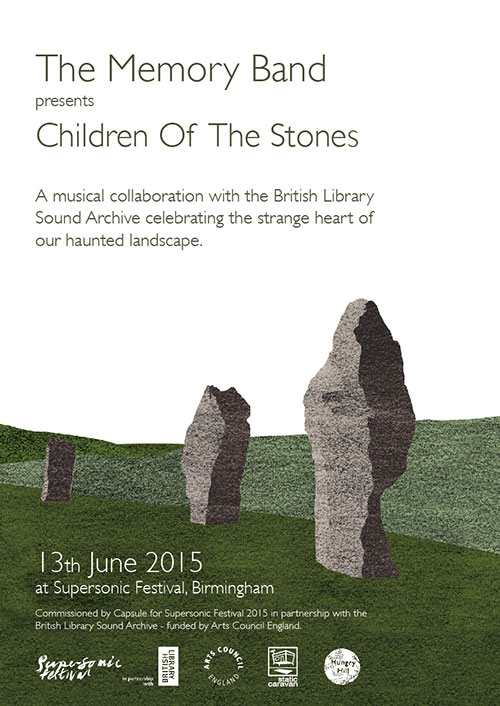
Stephen Cracknell, founder of The Memory Band, has worked with selected material from the Library’s archive to create a new work, Children of the Stones  is intended as a sonic adventure into the strange heart of our haunted landscape. . Mixing archival recordings, natural and industrial sounds, traditional melodies and original field recordings alongside a new acoustic score, the performance will celebrate the strange, mysterious and playful relationship we have developed with the ancient and magical landscape we inhabit.

Since 2003 The Memory Band has been mapping the mutant edgelands of British Folk music, where digital machinery and acoustic music combine to make traditional music from the future.

The Children of the Stones performance will take place on Saturday 13 June as part of Supersonic Festival

To accompany the commission there will be a ltd edition seven inch record on sale containing audio from the performance via Static Caravan Records.

The British Library is home to the nation’s sound archive, an extraordinary collection of over 6.5 million recordings of speech, music, wildlife and the environment, from the 1880s to the present day. It has recently launched the Save our Sounds programme which is a major digitisation project to preserve the nation’s sound heritage – read more here: www.bl.uk/projects/save-our-sounds

SHARE:

Supersonic Commission: British Library Sounds

ss_bl

Open call for British Library Sounds Commission

To be premiered at the Supersonic Festival


Deadline for applications: 5pm Friday 27 March 2015

Commission dates: April – June 2015

Performance/installation:

Supersonic Festival, Birmingham, June 11 – 14 2015


Supersonic Festival are delighted to be partnering with the British Library to offer an opportunity for an artist to develop a new work as part of the festival programme in June 2015. The successful artist will have the opportunity to work with selected material and their associated documentation in the Library’s archive to create a new work culminating in a performance or an installation at the festival, as well as being archived within the British Library’s sound collection.


This commission will be presented at the Supersonic Festival, 11 – 14 June, the UK’s premier experimental music and arts festival. Its international reputation and multidisciplinary programme draws audience, artists and industry professionals from across the globe ensuring a great showcase for this new work. For more information on the festival visit www.supersonicfestival.com


The British Library is home to the nation’s sound archive, an extraordinary collection of over 6.5 million recordings of speech, music, wildlife and the environment, from the 1880s to the present day. It has recently launched the Save our Sounds programme which is a major digitisation project to preserve the nation’s sound heritage www.bl.uk/projects/save-our-sounds.


For this commission, selection of wildlife and environmental recordings from the collection will be made available and will include, among other things, the songs & calls of British birds, the soundscapes of natural habitats such as woodland, marshland and the British coastline, and a range of environmental recordings covering weather, waves, streams, rivers and more. Additonal content from other curatorial areas may also be available, subject to availability and rights clearance
More information on the collections can be found at http://sounds.bl.uk


The selected applicant will receive a £750 fee for the development and performance of the commission. They will receive mentoring from the Supersonic team and an introduction to the collections from the British Library’s Curator, Wildlife and Environmental Sounds.


How to Apply:

To apply please send a proposal that includes all of the following:

Your name, contact details and website address.

A short statement explaining why you want to undertake the commission and what you hope to gain by working in this context (300 words max). Also tell us about two pieces of recent work that you are most proud of (200 words max) please save these documents together as a PDF or .doc file.

Evidence of your current work in the following form:

2 x links to your work uploaded to Soundcloud or You Tube/Vimeo.

Please send to [email protected] with ‘BL_SS commission’ in the title
Email attachments must not be larger than 5MB. Application is by email only.

Deadline for applications: 27 March 2015

SHARE:

The Paperless Stack / Sat 7th Dec

This blogpost was written by Beth Bramich for Eastside Projects, they present The Paperless Stack panel discussion on Saturday 7th December at Library of Birmingham, part of Volume.
The new Library of Birmingham is a huge investment in a public resource for the city at a time when the future of libraries across the country is uncertain.
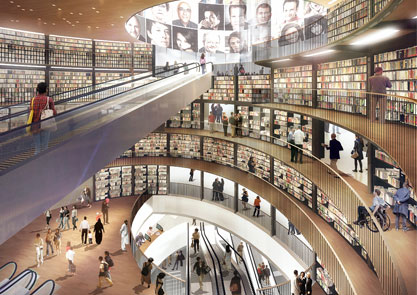

 Interior, the Library of Birmingham. When explaining her vision for the Library lead architect Francine Houben said, “We don’t know what the future of the library will be so we have designed space for change, to last over the next 100 years.”

The new Library is intended to act as a centre for the community. Aiming to transform lives through learning, knowledge and culture, its remit stretches far beyond what we might expect from a traditional library, offering spaces to socialise, access local history, develop a business plan, attend a theatrical performance, visit an exhibition and more. But as much as the new Library embraces its many roles and seamlessly incorporates new technology throughout, it puts books at its heart.

The Library has been built to house a collection of over a million physical books, including printed materials dating from the 17th Century housed in the Shakespeare Memorial Library, but it has also been shaped by the digital innovations that have developed over the last two decade in publishing.

New digital formats for books are revolutionising the way we read. Accessed both through computers, mobile phones, tablets and dedicated devices, e-books offer readers instant access to the books that they want, and additional features such as search functions and a networked reading experience. E-book sales surged during 2011-2012 (in the US surpassing sales of hardcover books for the first time in early 2012) and while they have levelled somewhat in 2013, demand remains high from those who have been completely converted to e-ink, to those who now happily read across many different formats.
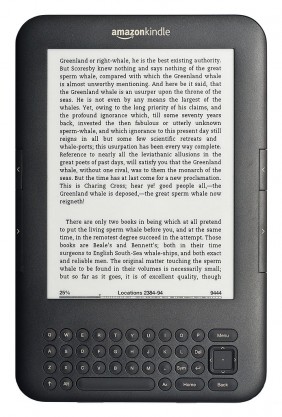
Third generation Amazon Kindle, showing text from the novel Moby-Dick.

At the same time as all these books, both print and digital, are being read, whether downloaded, bought online or picked up in your local book store, library usage is down. This is putting libraries, particular small local libraries, under pressure, as cuts to funding for local authorities are causing all spending on public services to be scrutinised.

One potential area for attracting new library users is to offer e-books as part of regular lending services. E-lending, where e-books can be borrowed from a library in the same manner as a physical book for a limited period of time, has had several set backs as a number of models for providing access to books and protecting their copyright have been put in place and then had to be re-worked as technology develops. A sustainable model that benefits publishers, libraries, authors and readers is still very much desired.

In the context of the new Library, which has responded to the challenges facing libraries by re-imagining its purpose and function, putting great emphasis on diversifying what it can offer and improving access to digital facilities, it is important to ask how all libraries can be resilient and adapt to the changing needs of their users.
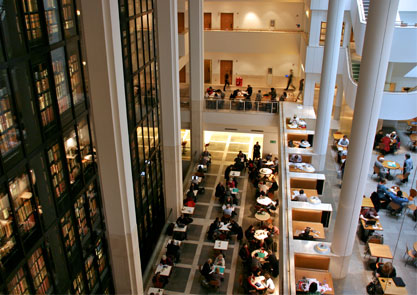

View of the King’s Library at the British Library. Photograph by Mike Peel.

Access to e-books is just one part of a larger conversation about what the public want and expect from library services today. Could a new breed of centralised super-library, offering online access to their resources, completely replace the local library? Do we even need physical libraries or would public money be better invested in, for example, offering greater access to the Internet?

The Paperless Stack will open up a debate about how new technologies used to translate and publish books in digital formats are affecting existing libraries and shaping the libraries of the future. With a panel of representatives from within the library sector, including Brian Gambles, Director of the Library of Birmingham and Lucie Burgess, Head of Content Strategy, Research and Operations at the British Library, the publishing industry and in the field of design this will be an in-depth discussion about what the library as an institution might become.

Saturday 7th December, 3pm.
Eastside Projects presents The Paperless Stack
Library of Birmingham
Free, booking via www.birmingham-box.co.uk

SHARE: